

Views: 0 Author: Site Editor Publish Time: 2025-04-11 Origin: Site


Current Air-Cooling Limits for High-TDP CPUs
The feasibility of air-cooling solutions for modern high-TDP CPUs in 1U and 2U servers is a critical challenge in data center infrastructure. Current industry benchmarks indicate that dual-socket 2U servers can support air-cooled CPUs with power consumptions up to 500W, while 1U dual-socket configurations max out at 400W per CPU. These thresholds are shaped by physical constraints such as chassis height, airflow dynamics, and heat dissipation area. For instance, Dell’s PowerEdge R6725 and HPE’s ProLiant DL365 Gen11 exemplify designs optimized for dual 400W AMD EPYC processors in 1U form factors. However, higher power densities often necessitate trade-offs—such as reduced storage configurations or forced airflow at higher fan speeds—thereby pushing practical limits.


The Role of Advanced Heat Sink Designs
A key innovation in extending air-cooling capabilities is the adoption of optimized heat sink architectures. Dell’s Remote HSK (Heat Sink Kit), for example, leverages an expanded surface area and repositioned CPU socket placement to enhance thermal transfer efficiency. In the single-socket 1U PowerEdge R470, this design supports Intel Xeon 6 E-Core CPUs with TDPs up to 330W. Although the Remote HSK’s surface area does not double traditional heat sinks, it may still boost cooling capacity by ~25% compared to conventional designs, theoretically enabling support for single-socket 500W CPUs in optimized 1U setups. However, thermal performance remains constrained by ambient temperature; for instance, reducing intake air from 35°C to 30°C can significantly improve headroom.
Challenges in Scaling Air-Cooling for Next-Gen CPUs
High-density server designs highlight the inherent limitations of air-cooling. NVIDIA’s DGX B200 system, which dissipates 14.3kW across 10U chassis (1,430W per rack unit), underscores the impracticality of air-cooling at extreme power levels. Similarly, Dell’s M7725 10U multi-node platform and Inspur’s 2U quad-node servers transition to liquid cooling for CPUs exceeding 2700W per U. Even in air-cooled systems, CPU socket and motherboard limitations emerge: Intel’s Xeon 6 69xxP “big-core” CPUs (400–500W TDP) require larger sockets incompatible with current 1U/2U server layouts, forcing vendors to prioritize energy-efficient cores (E-Cores) for space-constrained designs.
Prospects for 500W+ Air-Cooled Solutions
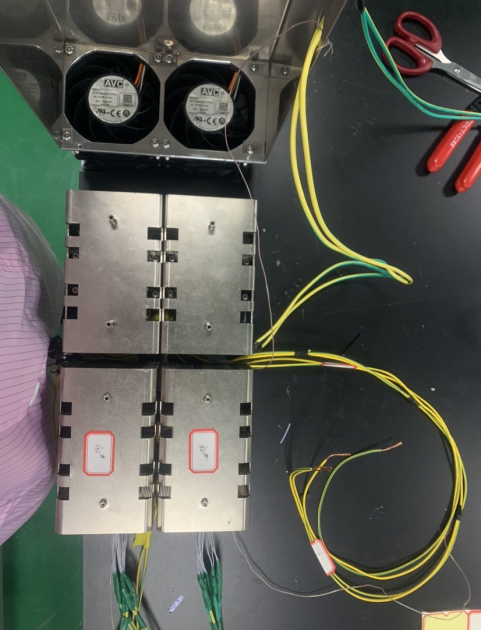
While current air-cooling technology is nearing its peak, incremental improvements could push boundaries. Single-socket servers—free from dual-CPU spatial constraints—offer room for larger heat sinks or asymmetrical motherboard layouts. For example, Dell’s concept study on the R6615 chassis proposes integrating Remote HSK-like designs to support 500W AMD EPYC 9005 CPUs in 1U configurations. In 2U servers, similar optimizations might extend air-cooling to 600W+ CPUs, especially with advances in heat pipe efficiency or material science. Nevertheless, such innovations must address practical barriers like power delivery (VRM design) and noise levels from high-RPM fans.
Conclusion: Balancing Innovation and Practicality
Air-cooling remains viable for mainstream servers with TDPs below 500W, but its scalability is inherently limited by physics. While novel designs like Remote HSK demonstrate potential for marginal gains, liquid cooling emerges as the inevitable solution for ultra-high-density workloads. Future advancements may focus on hybrid systems—combining air-cooling for lower-TDP components with targeted liquid cooling for CPUs—to balance efficiency, cost, and performance. For now, server manufacturers must navigate the delicate equilibrium between pushing air-cooling limits and embracing next-gen thermal management paradigms.

