

Views: 0 Author: Site Editor Publish Time: 2025-06-26 Origin: Site


Efficient thermal management is critical in high-power applications such as electric vehicles (EVs), data centers, and advanced electronics. Liquid cooling plates with phase-change capabilities (liquid-to-gas transition) offer superior heat dissipation compared to traditional single-phase systems. However, their design requires careful consideration of flow dynamics, pressure management, and material selection to ensure safety and performance. This article outlines key design principles, safety standards, and optimization strategies for phase-change flow channels in liquid cooling plates.
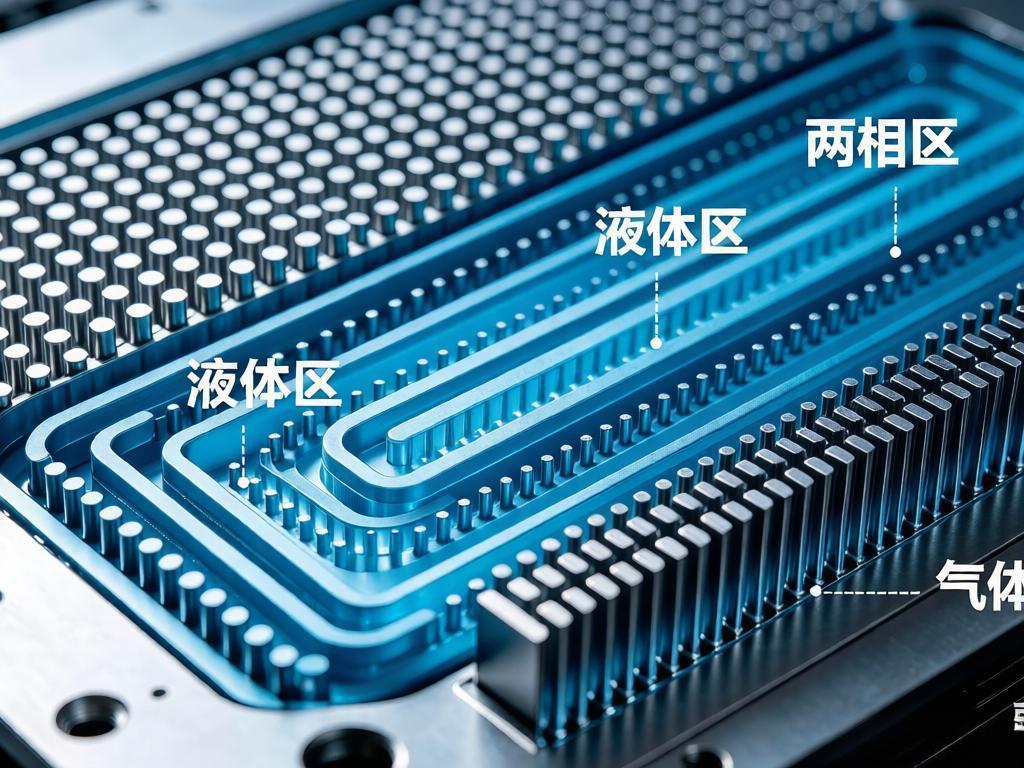
To maximize heat transfer efficiency, cooling plates should be divided into distinct zones based on the phase state of the coolant:
Liquid Zone: Narrow channels (≤3mm width) promote turbulent flow, enhancing convective heat transfer.
Two-Phase Zone: Wider channels (≥5mm) reduce flow velocity, preventing steam blockage while allowing bubble formation.
Gas Zone: Further expansion facilitates vapor evacuation, minimizing pressure buildup.
Microstructures improve nucleate boiling, delaying critical heat flux (CHF) and enhancing heat transfer:
Micro-Pillars or Fins: Structures 5–10mm in height with a 1:1 to 1:2 pitch ratio increase nucleation sites.
Cross-Sectional Shapes: Parallel, hourglass, or double-layer pillars optimize heat transfer under identical flow conditions (validated via CFD simulations like FloEFD).
Proper steam handling prevents localized pressure spikes and ensures stable operation:
Independent Steam Chamber: A top cavity (≥8mm height) with guide slots directs vapor to the outlet, avoiding stagnation.
Asymmetric Channels: Trapezoidal cross-sections (narrow base, wide top) enhance bottom-side heat absorption while promoting vapor expulsion from the top.
Phase-change cooling systems operate under high pressure, necessitating robust design:
Design Pressure: Must exceed 1.5× the saturation pressure (e.g., 0.33MPa for 100°C water).
Burst Pressure: Should be at least 3× the working pressure to prevent catastrophic failure.
Compliance: Follow ASME BPVC Section VIII for pressure vessel certification.
Seals: FFKM rubber (fluorinated elastomer) withstands -40°C to 200°C and resists steam corrosion.
Materials: 3003 aluminum or titanium are preferred over copper-aluminum hybrids to avoid galvanic corrosion (potential difference >0.3V can lead to electrolytic degradation).
Piezoelectric Steam Sensors: Detect leaks with sensitivity ≤10ppm, triggering automatic shutdown.
Redundant Sealing: Dual O-ring designs improve reliability in high-vibration environments.
Nano-Porous Coatings: Sintered copper powder (60% porosity) in two-phase zones reduces bubble detachment time by 30%, preventing localized overheating.
Dynamic Flow Regulation: Adjusting mass flow rate (Q = ṁ·hfg/Aheat) ensures ≤5°C/cm temperature gradients, avoiding dry-out zones.
Tree-Like Fractal Channels: Hierarchical branching minimizes flow maldistribution, improving temperature uniformity.
Biomimetic Designs: Leaf-vein-inspired channels enhance heat transfer by 30% compared to traditional straight channels.
Pressure Relief Mechanisms: Shape-memory alloy valves auto-expand at >90°C, providing rapid steam venting (response time <30ms).
Active Flow Control: Variable-speed pumps adjust circulation to match heat load fluctuations.
Micro-pillar channels (3mm diameter, 3mm spacing) achieve 500W/cm² cooling, doubling traditional single-phase systems.
Reduced pump power consumption due to enhanced heat transfer efficiency.
Shape-memory alloy valves ensure instantaneous steam venting during thermal runaway, preventing battery damage.
Thermal uniformity within ±2°C across battery packs, extending lifespan.
MIL-STD-810G: 500 pressure cycles (0.1MPa → design pressure) with leakage <1×10⁻⁷ mbar·L/s.
Hydrostatic Testing: 1.5× design pressure for 1 hour with no deformation.
Gradually increase power input until dry-out occurs, ensuring CHF ≥120% of design value.
Infrared thermography to detect hotspots during operation.
Phase-change liquid cooling plates offer unmatched thermal performance but require meticulous design to ensure safety and reliability. By following zonal optimization, microchannel enhancements, and strict pressure management, engineers can achieve efficient cooling for EVs, data centers, and high-power electronics. Future advancements in nano-coatings and smart flow control will further improve system stability and energy efficiency.
To learn more about the relevant content, feel free to visit our website: www.greatminds-cn.com ,If you have any questions, please contact us at info@greatminds.com.cn

