

Views: 30 Author: Site Editor Publish Time: 2026-01-20 Origin: Site


As high-speed optical modules evolve towards higher density and miniaturization, the conflict between thermal performance and mechanical structure has become a widespread industry pain point. Mature form factors like CFP2 often face the fundamental contradiction between "enhanced cooling requiring space" and "fixed system layout space." This article systematically deconstructs, through a typical case study, how to achieve dual breakthroughs in performance and compatibility without altering the main system architecture, via innovative thermal conduction processes and co-design of structures.
A communication equipment manufacturer encountered a typical thermal-mechanical coupling challenge in its CFP2 optical module system: uneven temperature distribution among modules resulted in a maximum temperature rise of 36°C, exceeding the 30°C design target. Simultaneously, the existing heatsink interfered with the system's mounting bracket, compromising overall integration reliability. This concurrent issue of "exceeding performance specs" and "installation conflict" represents a common real-world dilemma in optimizing and upgrading high-density equipment.
Thermal Performance Root Cause Resolution: Systematically analyze and resolve the uneven temperature distribution to stably control the temperature rise within 30°C.
Structural Conflict Elimination: Redesign the heatsink to completely resolve interference with the mounting bracket within the limited space.
Delivery of a Production-Ready Solution: Ensure the optimized solution possesses excellent manufacturability, cost competitiveness, and rapid delivery capability.
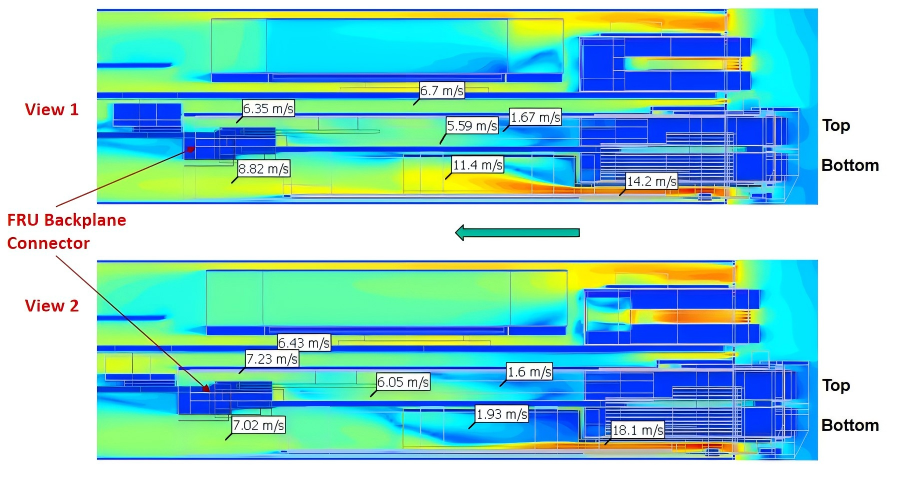
Utilized CFD tools for system-level fluid-thermal coupling simulation, accurately revealing the root cause of uneven airflow distribution among modules.
Conducted bottleneck analysis on the thermal conduction paths and structural layout of the original heatsink, combining thermal test data to clarify optimization directions.
Thermal Path Revolution: Upgraded the heat pipe's internal structure from the traditional grooved sintered copper mesh to a single-sided sintered copper powder process. This key process change significantly enhanced capillary force and heat transfer efficiency, forming the core foundation for performance improvement.
Structural Co-Design: Innovatively developed an ultra-thin heat pipe heatsink with a thickness of only 1.5mm, 25% thinner than the original design, fundamentally eliminating mechanical interference. Concurrently, a symmetrical heatsink architecture was adopted to optimize the internal airflow field, and DFM (Design for Manufacturability) analysis was integrated from the initial design phase to balance performance, cost, and manufacturing ease.
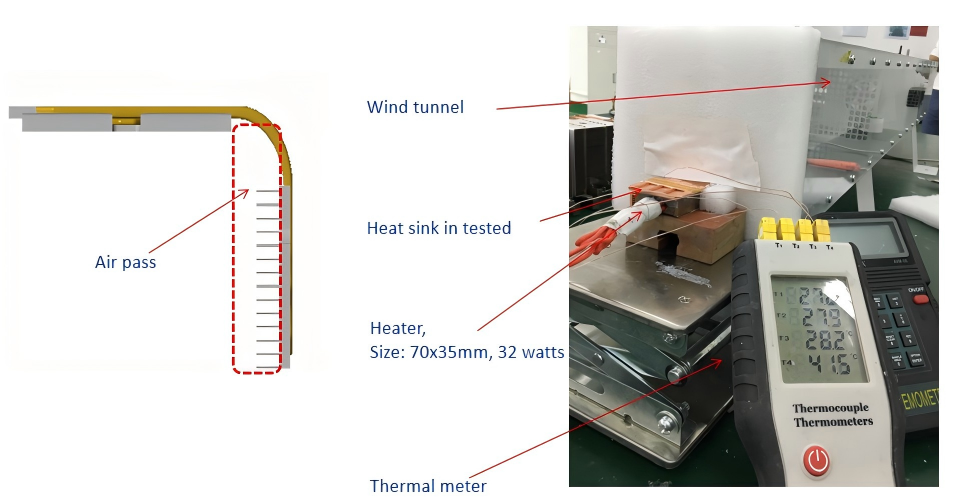
Fabricated optimized prototypes and completed thermal performance and structural reliability tests under actual operating conditions of 32W/10CFM.
Provided end-to-end ODM delivery support from simulation analysis and design optimization to prototype trial production, assisting the client in rapidly completing product iteration.
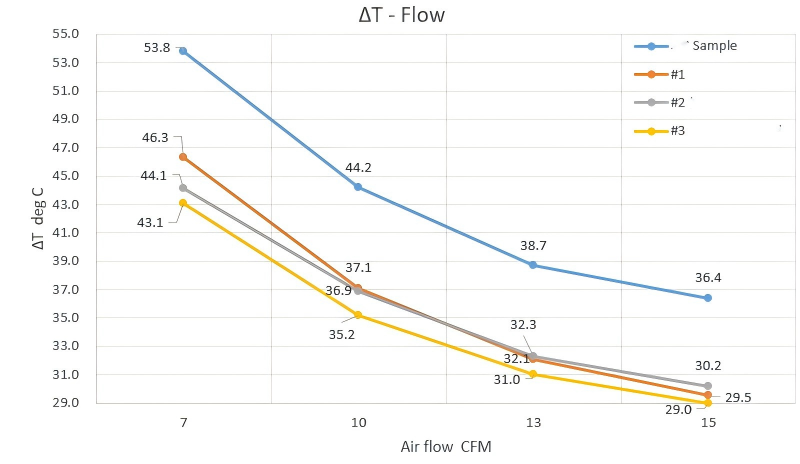
Thermal Performance: The CFP2 optical module's maximum case temperature was reduced by 9.6°C, with the temperature rise stably controlled within the 30°C target.
Structural Compatibility: The heatsink achieved interference-free installation and passed全套 mechanical and environmental reliability validations.
Client Value: Provided the client with a path for "in-situ thermal upgrade" without changing the main system architecture, significantly shortening the product optimization cycle.
Thermal-Mechanical Co-Design is the Essential Path: In high-density integration, thermal management must be iteratively optimized alongside mechanical design as a single set of variables, pursuing system-level compatibility and mutual benefit.
Process Innovation is the Lever for Performance Breakthroughs: When external dimensions are fixed, upgrading the internal processes of core heat conduction components (e.g., heat pipes) is often the most effective route to achieving a performance leap.
Optimizing Mature Products Requires Systems Thinking: Improvements to already mass-produced platforms require a system-level simulation-based diagnostic approach and a complete闭环 from problem identification and innovative design to rapid validation to minimize impact on existing supply chains and product timelines.
To learn more about the relevant content, feel free to visit our website: www.greatminds-cn.com. If you have any questions, please contact us at info@greatminds.com.cn.


