

Views: 94 Author: Site Editor Publish Time: 2019-09-24 Origin: Site


A heatsink is something that helps the CPU emit heat. On the one hand, CPU overheating accelerates aging, on the other hand, it also greatly reduces performance. Actually the heatsink is very cheap, so it is necessary to choose a good heatsink. Let's first briefly understand the structure and working principle of the heatsink.
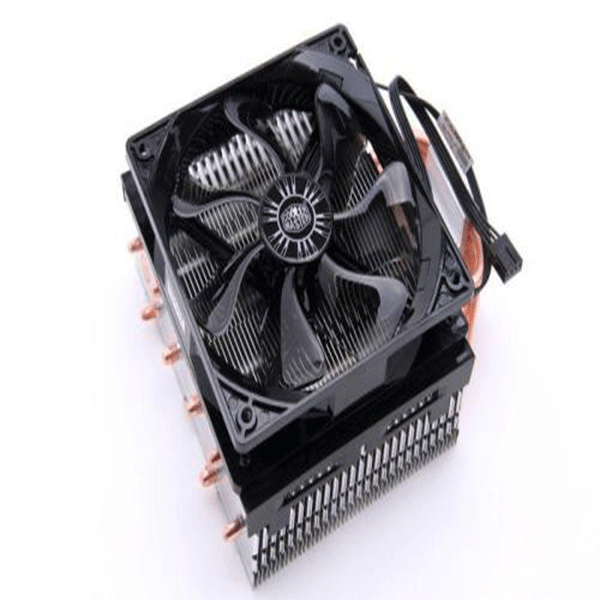
The heat transfer base is fixed on the CPU tightly, transferring the heat from the CPU to the heat conducting copper tube, which contains the heatpipe solution. It evaporates when heated and transfers heat to the fins. The function of fins is to distribute heat evenly, and then blow heat away by fans.
Therefore, when choosing CPU heatsinks, we should pay attention to the number of heat conducting copper tubes, the workmanship of heat transfer base, the size of fins and the volume of fan.
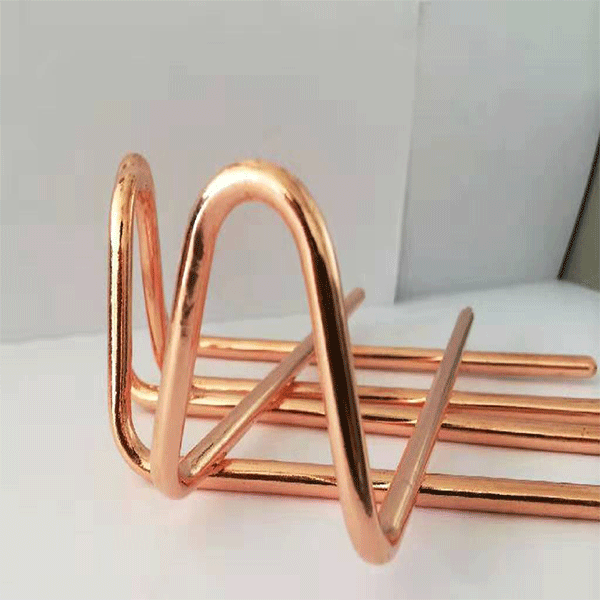
Heat pipe is the key component affecting heat transfer. Most of the heat pipes are 6mm and a few are 8mm. The more heat pipes you use, the better the heat dissipation will be. Two heat pipes are enough for home office. Four heat pipes are the mainstream nowadays. Four heat pipes are enough without CPU overrunning. Over-frequency players can choose six or more heat pipes.
In addition, the heat pipe can be divided into nickel plating and non-nickel plating. Nickel-plated heat pipes are shiny silver and have the function of anti-rust and anti-corrosion, so they can be used efficiently for a long time.
The base should be absolutely flat so that it can contact CPU fully. If the base is not flat, heat pipes will not be useful. Therefore, the workmanship of the base should be absolutely excellent.
There are three kinds of heat transfer base at present. The cheapest direct contact of heat pipe is to flatten and polish the heat pipe to ensure the smoothness of the base. This also causes the bottom heat pipe to become very thin, which may lead to pits and depressions over a long period of time, resulting in low thermal conductivity.
Copper base welding is to wrap the heat pipe completely with a polished copper base as smooth as a mirror, which solves two major drawbacks of direct contact of the heat pipe. Most high-end radiators use this base now.
Heat sinks with soaking plates are rare. High-end notebooks use this more. It also adds heatpipe solution to the base. After being heated, the evaporation transfers heat evenly to the whole base. And the heat conduction efficiency is also higher.
Fins are responsible for dispersing heat into the air. Therefore, it mainly depends on the contact area between fins and air. This means that the more fins are used, the better the heat dissipation is.
In addition, the heat pipe is inserted between the fins. Therefore, the process of their combination also affects the efficiency of heat conduction.
The reflow process is to weld the heat pipe and fins together. Its cost is high, but it is firm, durable and expensive.
The piercing process is to insert the heat pipe directly into the fin with low cost. But the requirements for workmanship and technology are very high. If the fin is inserted well, it will not be easy to loosen. If the fin is not inserted well, it will not take long for the fin to loosen. Thermal conductivity can not be guaranteed. So it is recommended to buy a mainstream brand. The price is not expensive, and quality is guaranteed.
This is to compare the fan volume and noise value. The air volume is expressed by CFM. The larger the air volume is, the better the heat dissipation is. The lower the noise value is, the smaller the noise is.
Because the main board of AMD platform is different from that of Intel platform. So before purchasing, we should see which platform it supports. Most of the radiators are supported by both platforms.
Scythe: This is a Japanese brand. The heatsink of the sickle house is excellent in workmanship. And the design in detail is very humanistic. Twisted copper tube technology can avoid memory strips and block memory. Among them, the price-performance ratio of the Red Rabbit Horse series heat pipe is very high, and the middle and low end heatsinks are preferred.
ID-COOLING: This is a Chinese brand. The product design feels great and has a high cost performance ratio. The main product is the downward pressure radiator for the small chassis. The most cost-effective Is-60 which is 6 heat pipe with nickel-plated and very luxurious configuration. It is about 150 yuan.
We will provide you with more knowledge about heatsinks. Follow us to learn more.


