

Views: 102 Author: Site Editor Publish Time: 2019-10-15 Origin: Site


The skived fin heatsink is widely used in our life, so let's take a look at it.
The skived fin heatsink is a radiator made of shovel-tooth technology. The shovel-tooth technology is mostly used for the heat dissipation of high-power parts, which is widely used in high-power motors because it has no loss of heat dissipation performance of the profile, while it can reach 100% of the original heat dissipation performance of the profile, and in addition, it has the characteristics of large size and high power.
The skived fin heatsink is a long plate which cuts the material into sheets and straightens at a certain angle through mechanical action, and repeatedly cuts to form a gap structure with consistent sequence, which is used for solving the heat dissipation of high-power devices under the condition of air cooling heat dissipation, and the efficiency of extrusion heatsink can be improved by 8-15% compared with the insert-piece radiator.
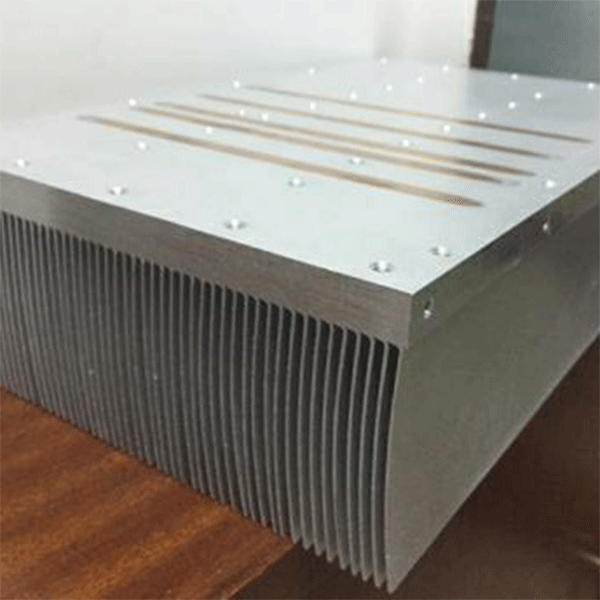
The production of skived fin heatsink requires mature shovel-tooth production technology, advanced large-scale shovel-tooth machine tools and technical cooperation of engineers. The heatpipe solution is essential. The specific production process is as follows:
(1) Customize the appropriate profile according to the design size, and then place the profile on the shovel tooth machine tool according to the correct operation mode.
(2) Set the parameters of the shovel tooth machine tool and input the shovel tooth data to be produced, such as tooth spacing, tooth height, tooth thickness and other data.
(3) Start the shovel tooth machine tool, and the engineer will monitor the machine tool and inspect the semi-finished products to see if they meet the data requirements. If there are any abnormalities, make adjustments.
(4) Cutting the semi-finished shovel tooth piece to a designated design size.
(5) Processing the cut semi-finished products, removing burrs, tapping, etc.
(6) If there is a design of buried heatpipe in the design drawing, the back of the Skived Fin Heatsink shall be grooved, pressed and welded with epoxy resin.
(7) Packaging the finished Skived Fin Heatsink to complete the whole production process.
Advantages:
(1) The radiating fin and the radiating base plate are made of a section bar without any connection point, and the heat conduction efficiency can reach 100% of the section bar material.
(2) The shovel teeth can make the VC heatsink thinner and improve the heat dissipation efficiency
(3) the processing technology is simple.

Disadvantages:
(1) The appearance is not cut or the combined radiator is symmetrical and beautiful.
(2) If the cast heatsink is shoveled very thin, it will result in insufficient hardness and easy deformation.
(3) The heat conduction efficiency is completely determined by the material of the radiator, and materials with ultra-high heat conduction efficiency such as soaking plates and heat pipes cannot be used like combined radiators.
The skived fin heatsink will be used more widely. The shovel-tooth technology can also be combined with other heat dissipation technologies, such as the heatpipe technology mentioned above, as well as water cooling plate technology and microchannel technology. Radiators with different shapes and sizes can be manufactured according to the characteristics of different motors. Matching different technologies can improve the performance of the radiator and reduce the cost at the same time. The shovel teeth do not have high requirements on the material of the profile, and can be aluminum profiles or copper profiles.


