

Views: 93 Author: Site Editor Publish Time: 2019-10-29 Origin: Site


The water-cooled heat dissipation system uses a pump to circulate the coolant in the heat pipe and dissipate heat. The heatsink is used to absorb heat from the computer CPU, north bridge, and graphics card. The heat absorbed by the heat absorbing part is discharged to the outside of the main body through a heatsink designed on the back of the fuselage.
In today's personal computer cooling field, although the air cooling heatsink is out of the strange circle of high noise and violent heat dissipation basically, it is generally moving toward large volume, multiple heat pipes, and super weight, which brings trouble to actual use in the heatsink. And the installation has brought a lot of inconvenience and great test to the bearing capacity of computer accessories. In view of the predicaments in the post-wind-cooling era mentioned above, the liquid cooling heatsink has gradually been accepted by the majority of computer users.
As a mature cooling technology, liquid cooling has been widely used in industrial applications such as automotive and aircraft engine cooling. The application of liquid cooling technology to the computer field is not because the air cooling has reached the end, but because the liquid dissipates much faster than the air. Therefore, the liquid cooling heatsink often has a good heat dissipation effect and noise can be well controlled.
Due to various advantages in heat dissipation like efficiency and quietness, liquid cooling and heat dissipation also appear after the popularity of computer air cooling. What is gratified is that, to this day, liquid cooling in the computer field is spreading. This situation is due to the great progress in the safety and stability of liquid cooling.
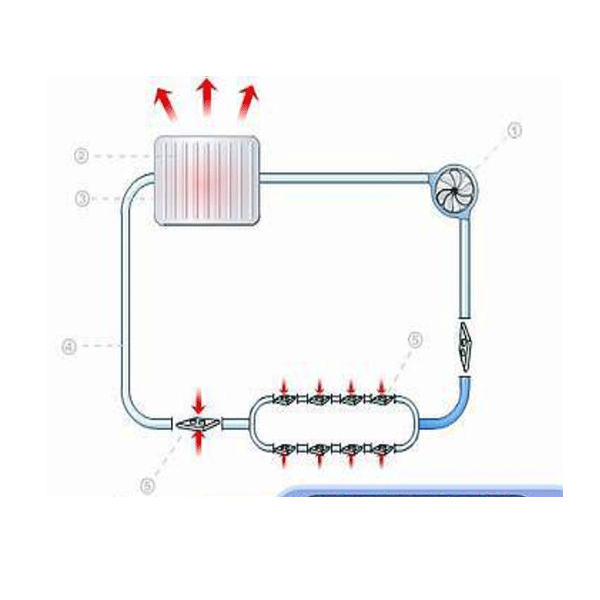
The nature of water cooling and air cooling is the same. It is only water-cooling that uses the circulating fluid to transport the heat of the CPU from the water-cooling block to the heat exchanger and then dissipates it instead of the air-cooled homogeneous metal or heat pipe. The heat exchanger part is almost a replica of the air-cooled radiator. The biggest features of the water-cooled cooling system are two: equalizing the heat of the CPU and low noise operation. Because the specific heat capacity of water is too large, it can absorb a large amount of heat and keep the temperature from changing obviously. The temperature of the CPU in the water cooling system can be well controlled, and the sudden operation will not cause a sudden and large change in the internal temperature of the CPU. Due to the large surface area of the heat exchanger, it is only necessary to use a low-speed fan to dissipate heat. This can be a good effect. Therefore, most of the water cooling is matched with a fan with a lower rotation speed. In addition, the working noise of the water pump is generally not obvious. So that the overall cooling system is very quiet compared to the air cooling system.
The liquid cooling system uses a pump to circulate and dissipate the coolant in the heat pipe. The heat absorbing part on the heat sink is used to absorb heat from the computer CPU, north bridge, and graphics card. The heat absorbed by the heat absorbing part is discharged to the outside of the main body through a heat sink designed on the back of the fuselage. That is to say, the biggest advantage of liquid cooling is that it can transfer heat to the heat sink without increasing the temperature inside the body, instead of using liquid to cool the computer parts. As long as we can improve the cooling performance of the heat radiated by the radiator to the air discharge duct, we can achieve a silent design by reducing the fan speed of the cooling radiator.
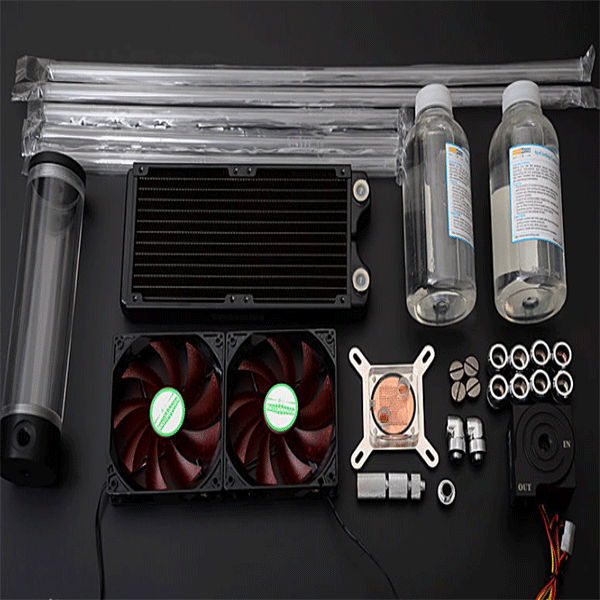
Another important advantage of liquid cooling is that the liquid has a large heat capacity and a slow temperature rise, which is beneficial to the computer to ensure that the CPU will not be burned in an instant.
After the power is turned on, the temperature rises slowly, and the air-cooled temperature rises quickly to a stable value. When the CPU has an unexpected event such as a large operation, the spike may instantaneously break the upper CPU temperature limit. Liquid cooling can filter this spike well and ensure the safety of the CPU.
With the mass production of liquid cooling systems, the price of liquid cooling packages is also acceptable to civilians. Professionals can assemble liquid cooling equipment according to their own needs. A detailed installation tutorial is available from many liquid cooling manufacturers. Liquid cooling technology will soon be used in smartphone devices. Apple, Samsung and HTC will consider adopting this technology in future devices.


