

Views: 90 Author: Site Editor Publish Time: 2019-09-11 Origin: Site


With the development of science and technology, when the number of integrated transistors on processor chips increases dramatically, heat generation has become the most important issue today. With the continuous improvement of chip power density, the VC heatsink has been widely used in heat dissipation of CPU, NP, ASIC and other power dissipation devices. The use of the VC heatsink allows direct contact between heat sources and equipment, thereby reducing thermal resistance. So what is electronic heatsink?
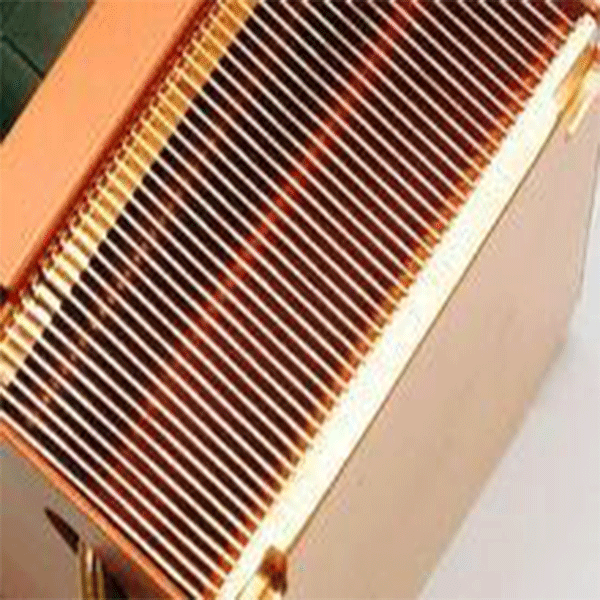
A electronic heatsink is a device for heat dissipation of easily heated electronic components in electrical appliances. It is made of aluminum alloy, brass or bronze, which is plate-shaped, flake-shaped, multi-piece, etc. The main function is heat dissipation. It can be cut to the required size according to the size of the component, such as heatsinks for high-power switching tubes or triodes. Of course, in the special case, the ultra-high-power electronic components also have a cooling fan. For example, the switching power supply switching pipes must be equipped with a cooling fan.

(1) There should be no shrinkage, corrosion, cracks and other defects on the surface of the radiator.
(2) The metal fasteners (pressure plate, cover, disc spring) of flat radiator and the conductive sheets of water-cooled radiator should be protected by coating.
(3) The maximum allowable surface roughness Ra of the heatsink table is 3.2m.
(4) The flatness of the electronic heatsink countertop is not less than 9 levels.
(5) Heatsinks (including fasteners and insulators) used in wet tropical power semiconductor devices, the surface should be protected, and their resistance to moisture, salt spray and mildew should meet the requirements of the corresponding tropical power semiconductor device standards.
(6) Special fasteners and insulators for radiators shall comply with the standards of GBB446.3.
(7) The tightening moment or tightening pressure of radiator and power semiconductor installation shall conform to the relevant provisions of device product standards.
(8) The mounting center locating pin size of the flat-shaped radiator table: 2.5mm in diameter, 1mm above the table surface.
(1) Material quality (purity, thickness, processing accuracy, etc.) and manufacturing technology (cracks and shrinkage holes produced by casting), inferior material quality, rough and defective technology will directly affect the thermal conductivity of the heatsink.
(2) The surface roughness and flatness of the contact surface of the electronic radiator directly affect the contact thermal resistance and pressure drop.
(3) The disc spring used in electronic radiator should ensure that the free height should be stable after 24 hours of flattening, otherwise the spring may fail after a period of use, which will lead to poor contact between radiator and tube core.
(1) According to the processing method: there are extrusion heatsinks, insert heatsinks, cast heatsinks, etc.
(2) According to the cooling method: there are natural cooling heatsinks, air cooling heatsinks, water cooling heatsinks, oil cooling heatsinks, cold plate heatsinks, heat pipe heatsinks and so on.
(3) According to professional purposes: high-power devices heatsinks, electronic heatsinks and so on. At present, electronic products mainly use patch packaging devices, but high-power devices and some power modules still have many perforated packages, which are mainly conveniently mounted on the heatsink for heat dissipation.
(4) According to the material used, there are aluminium heatsinks, copper heatsinks and steel heatsinks.
(5) According to the power, there are low-power heatsinks, medium-power heatsinks and high-power heatsinks.


