

Views: 77 Author: Site Editor Publish Time: 2020-02-04 Origin: Site


Switches are upgraded from the original hubs, which are not very different from hubs in appearance. Because the two ends of communication need to transmit information, and the way of sending the information to the corresponding router meets the required standards by equipment or manual means, which is called the switch technology. Generally speaking, in the communication system, the equipment that realizes the function of information exchange is the switch.
Exchange is a general term for the technology of transferring the information to the corresponding routing according to the need of transmitting information at both ends by means of manual or automatic equipment. Switch have multiple ports, each of which has a bridge function, and can connect to a LAN or a high-performance server or workstation. So switch are sometimes referred to as multi-port bridges.
A network switch is a network-expanding device that provides more ports for sub-networks to connect to more computers. With the development of the communication industry and the advancement of national economy information, the network switch market has shown a steady upward trend. It has the characteristics of high cost performance, high flexibility, relatively simple and easy to implement. Ethernet technology has become the most important LAN networking technology today, and network switch has become the most popular switch.
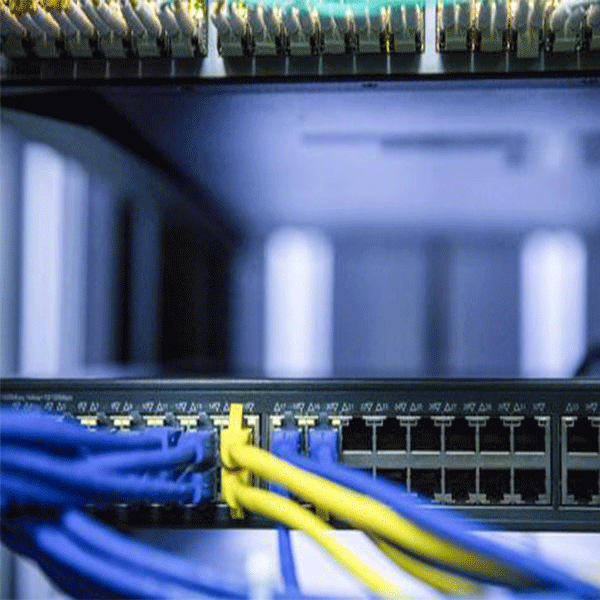
In 1993, local area network switching equipment appeared. In 1994, there was a boom in switching network technology in China. In fact, switching technology is a switching product with low-cost, high-performance and high-port-intensive features, which embodies the complex switching technology of bridging technology in the second layer of OSI reference model operation. The switch forwards the information relatively simply by the MAC address in each packet. This forwarding decision generally does not consider deeper information hidden in the package. The switch has a small forwarding delay and operates similarly to a single LAN performance.
Switching technology allows shared and dedicated LAN segments to adjust their bandwidth to alleviate bottlenecks in the flow of information between LANs. Switch offers many networking features as traditional bridges, it economically divide the network into small conflict domains, providing higher bandwidth for each workstation. The transparency of the protocol allows the switch to be installed directly in a multi-protocol network with simple software configuration. The switch uses existing network cables, repeaters, hubs, and workstations, eliminating the need for high-level hardware upgrades. The switch is transparent to the workstation, so the management cost is low, and the operation of adding, moving, and changing network nodes is simplified.
With specially designed integrated circuits, switch can transmit information in parallel at line rates at all ports, providing much higher operational performance than traditional bridges. ASIC technology enables switch to achieve the above performance with more ports, and the cost of ports is lower than that of traditional bridges.
(1)Broadly speaking, there are two types of network switch: WAN switch and LAN switch. WAN switch are mainly used in the telecommunications field to provide a basic platform for communication. LAN switch are used in local area networks to connect terminal devices such as the PC, the network printer and so on.
(2)From the transmission medium and transmission speed, it can be divided into Ethernet switch, Fast Ethernet switch, Gigabit Ethernet switch, FDDI switch, ATM switch and Token Ring switch.
(3)From the scale application, it can be divided into enterprise-level switch, department-level switch and workgroup-level switch. The scale that each manufacturer divides is not entirely consistent. Generally speaking, enterprise-level switch are rack-type, department-level switch can be rack-type (with fewer slots) or fixed configuration, while workgroup-level switch are fixed configuration (with simpler functions). On the other hand, from the perspective of the scale of the application, the switch supporting large enterprises with more than 500 information points is an enterprise-level switch, and the switch supporting medium-sized enterprises with less than 300 information points is a department-level switch, the switch supporting less than 100 information points is a workgroup-level switch.
switch are the most commonly used devices, and they can be found in almost all network construction. Most of the time, switch need to work 24 hours uninterruptedly, which puts forward higher requirements for heat dissipation.

Installing a heat sink inside the switch can better dissipate heat from the switch. The heatpipe solution needs to scientifically and rationally arrange the heat conductive silicone sheet, heatsink, fan, cpu and other components to ensure good heat dissipation and improve the stability of the switch.


