

Views: 83 Author: Site Editor Publish Time: 2020-02-25 Origin: Site


LED lighting is a kind of semiconductor solid-state light-emitting device. It uses solid semiconductor chips as luminescent materials and emits excess energy through carrier recombination in semiconductor, which directly emits red, yellow, blue and green light. On this basis, using the principle of three primary colors, adding phosphors, any color light can be emitted. The illuminator made by using LED as light source is the LED lamp. In LED lighting fixtures, LED lighting fixtures for reflective purposes can be fully qualified for any occasion, and large area indoor lighting is not mature.
Using the principle of semiconductor P·N junction light source, LED was made in the early 1960s. In 1964, red light emitting diodes first appeared, and then yellow LED appeared. It was not until 1994 that blue and green LEDs were successfully developed. In 1996, white LED was successfully developed by Nichia Company of Japan.
Because of its inherent characteristics, such as power saving, long life, vibration resistance, fast response and cold light source, LED is widely used in indicator lights, signal lights, display screens, landscape lighting and other fields. It can be seen everywhere in our daily life, such as household appliances, telephones, dashboard lighting, automobile anti-fog lights, traffic signal lights and so on. However, due to the limitations of its poor brightness, high price and other conditions, it cannot be used as a universal light source.
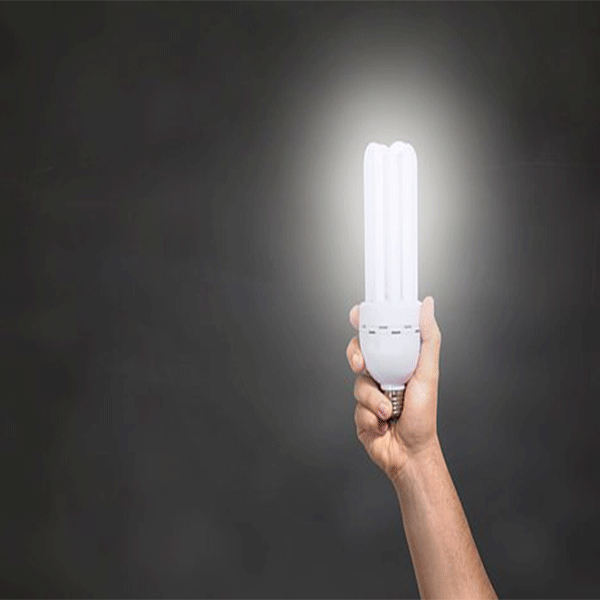
In recent years, with the deepening of the research on semiconductor luminescent materials, the continuous progress of LED manufacturing technology and the development and application of new materials (nitride crystals and phosphors), breakthroughs have been made in ultra-high brightness LED of various colors. Its luminescent efficiency has increased by nearly 1000 times, and all colors in the visible light band have been achieved in terms of chromaticity. The emergence of ultra-high brightness white LED, the most important of all color bands, makes it possible for LED applications to leap into the high-efficiency lighting source market. It has been pointed out that high brightness LED will be one of the greatest inventions after Edison invented incandescent bulb.
With the global consensus on the development of a low-carbon economy, the LED lighting industry will usher in valuable and rapid development opportunities with its performance advantages in the field of energy saving and consumption reduction. In the current low-carbon economy, the LED lighting industry market is heating up and competition is becoming increasingly fierce. In 2011, the total industrial output value of China's LED lighting industry reached 73.015 billion yuan.
LED is called the fourth-generation illumination source. It has the characteristics of energy saving, environmental protection, long life and small size. It can be widely used in general lighting and urban landscape lighting. Some economically developed countries in the world have launched a fierce technical competition around the development of LEDs. The United States has invested $500 million since 2000 to implement the National Semiconductor Lighting Program. The European Union also announced the launch of "The Rainbow Program" in July 2000. Under the support of "The 863 Program", the Ministry of Science and Technology of China first proposed the development of semiconductor lighting plans in June 2003.
Heat dissipation is a major factor affecting the decay and service life of LED lights. In order to enhance the heat dissipation capacity of LED lighting system, the materials with high specific heat and high heat conductivity are generally used in the heatsink of LED lamps. The extrusion heatsink extrudes the liquid aluminum through a fixed die and then machined the bar into a heat sink of the desired shape. The heat dissipating wings can be made a lot of thin, and the heat dissipating area is maximized. When the cooling fins work, the air convection heat is automatically formed, and the heat dissipating effect is better. Various kinds of led heat sink can be chosen such as led bulb heat sink, 100w cob led heatsink, 50w led heatsink, led aluminum heatsink etc.
Over the years, LED lighting has attracted the attention of the state and governments at all levels for its advantages of energy saving and environmental protection, and relevant policies and measures have been introduced to speed up the development of LED lamps and lanterns all over the country. The public consumers have long been longing for this new type of environmental protection lighting products.


