

Views: 81 Author: Site Editor Publish Time: 2019-12-31 Origin: Site


A display is also commonly referred to as a monitor. A display is an I/O device belonging to a computer, that is, an input/output device. It is a display tool that displays certain electronic files onto a screen through a specific transmission device and then reflects them to the human eye. In this passage, we will introduce the working principle and common types of display.
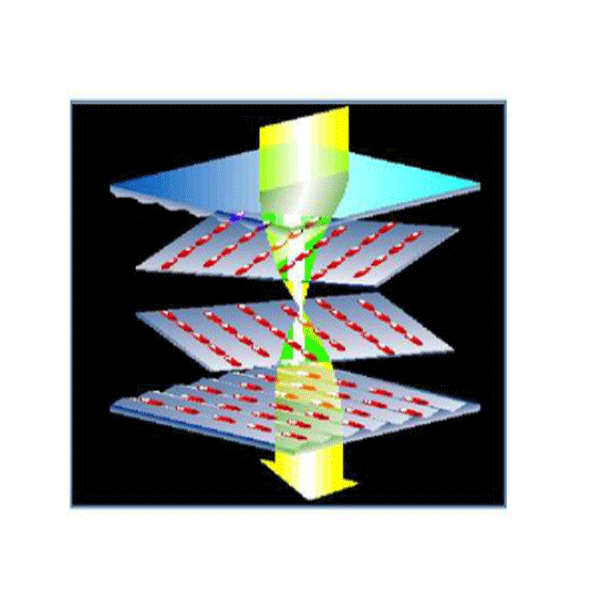
Liquid crystal is a very special substance. It flows both as a liquid and has some optical properties of the crystal. Under the action of the electric field, the arrangement of liquid crystal molecules changes, which affects its optical properties. This phenomenon is called electro-optical effect. Usually, an alignment film is arranged on two glass substrates, and the liquid crystals are aligned along the grooves. Since the alignment grooves of the glass substrate are deviated by 90°, the molecules in the liquid crystal are arranged neatly in the same plane like a louver, and the orientation of the molecules gradually reverses by 90° when the column transitions from one liquid level to the other. Generally, the most commonly used liquid crystal type is a nematic liquid crystal, the molecular shape is an elongated rod shape. Under different electric current fields, the liquid crystal molecules are regularly rotated by 90 degrees to produce a difference in transmittance. In this way, the difference between light and dark is generated by the power on and off, and each pixel is controlled by this principle to form a desired image.
From the early black and white world to the color world, the display has gone through a long and arduous process. With the continuous development of display technology, the classification of displays has become more and more detailed. In this article, we will introduce five kinds of displays.
It is a display using a cathode ray tube. The cathode ray tube is mainly composed of five parts: an electron gun, a deflection coil, a shadow mask, a phosphor layer and glass casing. It is one of the most widely used displays. CRT displays have the advantages of large viewing angle, no dead pixels, high color reproduction, uniform chromaticity, adjustable multi-resolution mode, and extremely short response time.
The LCD display, that is, the liquid crystal display, has the advantages of a thin body, a small footprint, and a small radiation, giving an image of a healthy product. However, the LCD screen does not necessarily protect the eyes, depending on the individual's habit of using the computer. There are many liquid crystal particles inside the display, which are regularly arranged in a certain shape, and the color of each side of them is divided into: red, green, and blue. The three primary colors can be restored to any other color. When the display receives the display data of the computer, it controls each liquid crystal particle to rotate to a different color surface to combine into different colors and images. Because of this, the shortcoming of the liquid crystal display is that the color is not bright enough and the viewing angle is not high.
LED is the light emitting diode. It is a display screen for displaying various information such as text, graphics, images, animations, quotes, videos and video signals by controlling the display mode of the semiconductor light-emitting diodes. The technological advancement of LED is the biggest driving force for expanding market demand and application. Initially, LEDs were only used as miniature indicator lights in high-end equipment such as computers, audio and video recorders. With the continuous advancement of large-scale integrated circuits and computer technology, LED displays are rapidly emerging and gradually expanded to stock market stocks, digital cameras, PDA and mobile phone fields.
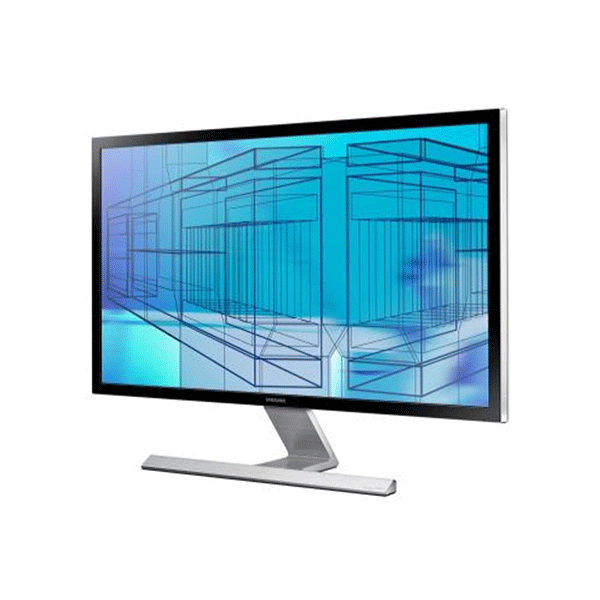
3D displays have long been recognized as the ultimate dream of display technology development, and many companies and research institutions have been engaged in research in this area for many years. Developed countries and regions such as Japan, Europe, America, and South Korea have been involved in the research and development of stereoscopic display technology since the 1980s. In the 1990s, they began to obtain different levels of research results. Now there are two stereoscopic display technology systems have been developed that one requires stereo glasses and the other do not require stereo glasses.
PDP (Plasma Display Panel) is a new generation of display devices using plasma flat screen technology developed in recent years. The imaging principle of the plasma display technology is that thousands of sealed small low-pressure gas chambers are arranged on the display screen which will produce ultraviolet light by the current excitation, and then the ultraviolet light hits the red, green and blue on the rear glass to emit visible light that can be seen by the naked eye to image. The superiority of the plasma display includes thin thickness, high resolution, small footprint and can be used as a wall-mounted TV in the home, representing the development trend of future computer monitors.
The heat dissipation of display can be achieved by fan heatsink, aluminum heatsink fins, heat pipe heat sink and so on.


