

Views: 78 Author: Site Editor Publish Time: 2019-12-17 Origin: Site


A server is a device that provides computing services. Since the server needs to respond to service requests and process them, the server should generally have the ability to take on the service and secure the service.
The server consists of a processor, a hard disk, a memory, a system bus, etc., which is similar to a general-purpose computer architecture, but the server has high requirements on processing power, stability, reliability and security. Do you know what the common shape of the server is? Let us know through this article.
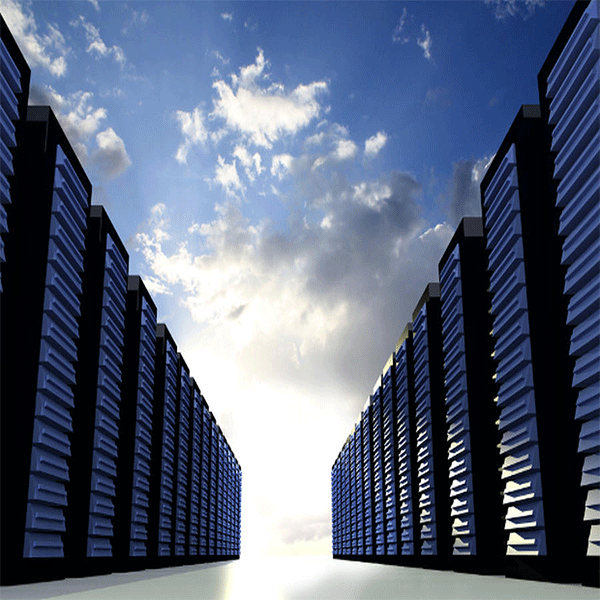
For information service companies (such as ISP/ICP/ISV/IDC), the server must first consider the physical parameters such as the size, power consumption, and heat generation of the server, because information service enterprises usually use a large dedicated computer room to uniformly deploy and manage a large number of server resources. The equipment room usually has strict security measures, a good cooling system, and multiple backup power supply systems. The cost of the equipment room is quite expensive. How to deploy more servers in a limited space is directly related to the service cost of the enterprise. A rack server with a mechanical size conforming to the 19-inch industry standard is usually selected.
The shape of the rack server does not look like a computer, but like a switch, it has 1U, 2U, 4U and other specifications. A typical 1U rack server is the most space-saving, but has poor performance and scalability, and it is suitable for some relatively fixed areas of business use. The products above 4U have high performance and good scalability. They generally support more than 4 high-performance processors and a large number of standard hot-swappable components. Management is also very convenient.
A blade server is a high-availability and high-density server unit that can accommodate multiple card-type server units in a standard-height rack cabinet. Each "blade" is actually a system motherboard.Administrators can use system software to aggregate these boards into a single server cluster. In cluster mode, all motherboards can be connected to provide a high-speed network environment while sharing resources to serve the same user base.
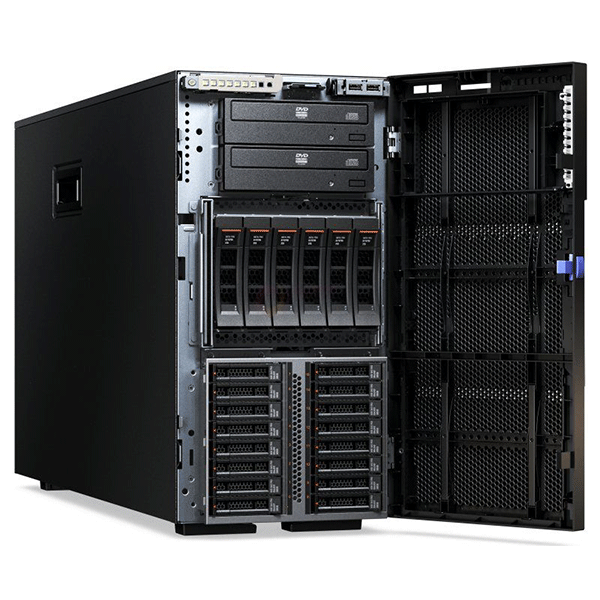
The tower server is a common server. Its shape and structure are a little larger than the vertical PC we usually use. The tower server has a large chassis, the server configuration can be very high, and the heat sink, cold plate and other expansions are complete. So its application range is very wide. It can be combined with a variety of common services, whether it is speed applications or storage applications can be solved using a tower server.
In some high-end enterprise servers, due to the complicated internal structure, there are many internal devices, and some have many different device units or several servers are placed in one cabinet. Such servers are rack-type servers. The cabinet type is usually a combination of rack, blade, and other equipment. It is often used in important enterprises such as securities, banks, post and telecommunications.
The above is about the shape of the server, you can pay attention to us or consult us for more server knowledge.


