

Views: 84 Author: Site Editor Publish Time: 2019-11-13 Origin: Site


With the coming of 5G era, the global science and technology field is accelerating rapidly. Modern data center undertakes a large amount of data calculation and storage, which requires better system performance on stability. In order to provide higher energy efficiency to meet the needs of business development, heat pipe solutions for servers and even computer rooms become the key.
The rapid growth of data center construction has led to more and more equipment in the equipment room. In order to ensure a constant temperature and humidity cooling environment in the data center, the power consumption of the data center will be greatly increased, and the cooling system, power distribution system, UPS and generators will increase proportionally, which will bring great challenges to the energy consumption of data center. The issue of energy consumption has become the biggest concerning in data center construction. So what are the cooling technologies in the data center? water cooling system or air cooling system?
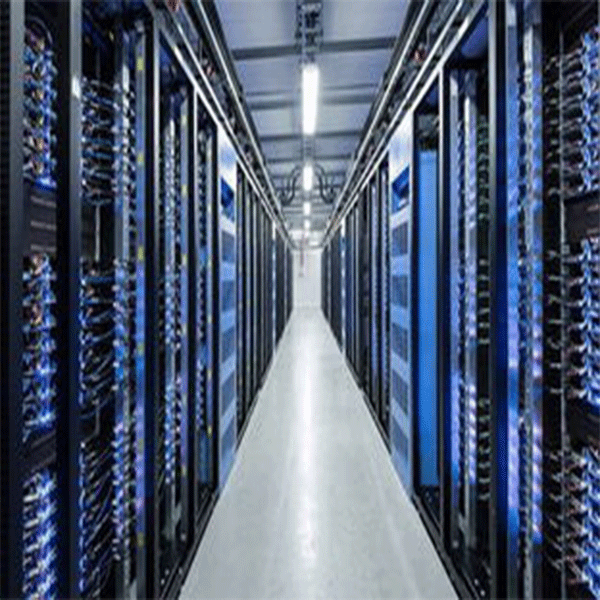
Evaporative cooling system is a method of cooling air by temperature drop. When water encounters flowing hot air, it begins to vaporize and become a gas. Evaporative VC heatsink dissipation is not suitable for environmentally hazardous refrigerants, its installation cost is low, and no need to use traditional compressors. It performs well on energy saving, environmental protection and improving indoor air quality. The evaporative cooler is a large fan that draws hot air onto the wet pad. When the water in the wet pad evaporates, the air will be cooled and pushed out. The temperature can be controlled by adjusting the cooler airflow. Adiabatic cooling means that the air rises in the process of adiabatic rise, the air pressure decreases with the increase of the height, thereby causing the temperature of the air itself to decrease. These cooling methods for data centers are novel.
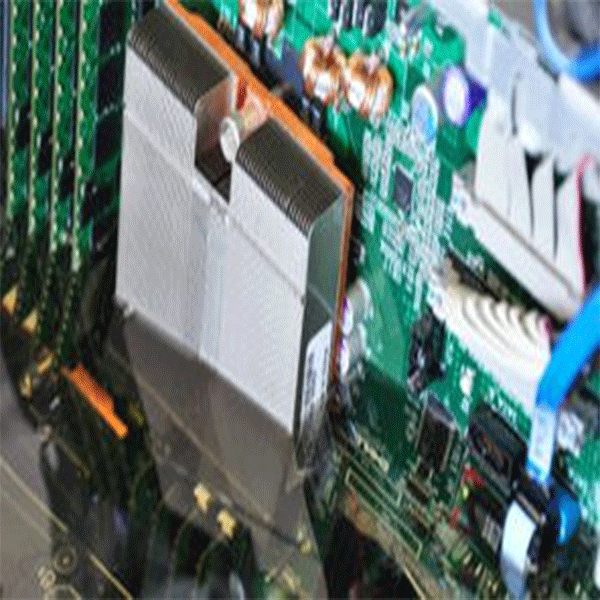
The enclosed cooling system heatsink cap is sealed with an expansion tank. During operation, the coolant vapor enters the expansion tank, and flows back to the cast heatsink after cooling, which prevents a large amount of evaporation loss of the coolant, and increases the boiling temperature of the coolant. Closed cooling system does not need to add cooling water for 1 to 2 years. When in use, it must be sealed. The coolant in the expansion tank should not be filled totally, leaving room for expansion. After two years of use, release the filter and adjust the ingredients and freezing point to continued use. Closed means that the air flow is insufficient and it is easy to cause local overheating. Closed cooling is often combined with water cooling system , and the water cooling system can also be used as a closed system to provide more heat dissipation and improve cooling efficiency.
The above describes the common techniques for data center cooling, some of which are still in the process of continuous improvement. For the future data center cooling trend, in addition to high-performance computing centers and other Internet-based data centers, most data centers will move to places where the price is cheaper and the power cost is lower. By adopting more advanced heat dissipation technology, the operation and maintenance costs of data centers will be further reduced and energy efficiency will be improved.


