

Views: 85 Author: Site Editor Publish Time: 2020-02-25 Origin: Site


LED lighting is a kind of semiconductor solid-state light-emitting device. It uses a solid semiconductor chip as a light-emitting material. In the semiconductor, the carrier recombines excess energy to cause photon emission, and directly emits red, yellow, blue and green light. On the basis of this, using the principle of three primary colors, a phosphor can be added to emit light of any color.
Advantages of LED Lighting
The spectrum of LEDs is almost entirely concentrated in the visible light band, and its luminous efficiency can reach 80-90%. Ordinary incandescent lamps have a luminous efficacy of 12 lm/w and a lifetime of less than 2000 hours. The spiral energy-saving lamp has a luminous efficacy of 60 lm/w and a life of less than 8,000 hours. The T5 fluorescent lamp is 96 lm/w and has a lifetime of approximately 10,000 hours. The white LED with a diameter of 5 mm has a luminous efficacy of 20-28 lm/w and the lifetime can be more than 100,000 hours. In addition, LED is a typical green lighting source with the advantages such as high light quality, basically no radiation, reliable and durable, extremely low maintenance costs and so on.
The working voltage of LED is low, mostly 1.4-3V. The working current of ordinary LED is only 10mA, and the ultra-high brightness is only 1A. LED does not need to add mercury in the production process, does not need to be inflated, does not need glass casing. It has good impact resistance, good shock resistance, not easy to break, easy to transport, very environmentally friendly, so it is known as "green energy."
The LED is small in size and light in weight. And the outer casing is epoxy resin package, which not only protects the internal chip, but also has the ability of light transmission and spotlight. The service life of LED is generally between 50,000 and 100,000 hours. Because LEDs are semiconductor devices, even frequent switching will not affect the service life.
The response frequency fτ of LED is related to the life of a few carriers injected τmc. For example, the response frequency of LED made of GaAs material is about 16-160mhz when its τmc is generally in the range of 1-10ns. Such a high response frequency is enough for displaying 6.5mhz video signal, which is also one of the key factors to realize the video LED large screen.
The luminous efficacy of incandescent lamps is 12-24 lm/w, the luminous efficacy of fluorescent lamps is 50-70 lm/w, and the luminous efficacy of sodium lamps is 90-140 lm/w. Most of the power consumption becomes heat loss. The luminous efficacy of the LED can be improved to 50-200 lm/w, and the monochromaticity of the light is good, the spectrum is narrow, and the visible light can be directly emitted without filtering. For high-power LED devices and lighting fixtures, as the power continues to increase, the temperature of the LED internal chip will gradually increase, and the performance of the LED internal chip and other devices will decrease with the temperature rise. Therefore, it is very important to choose the appropriate heatpipe solution. In the selection of led light heatsink, you can choose extruded aluminum heat sink, die cast heat sink, vapor chamber heatsink,skiving heatsink, led heat pipe etc. They can solve the impact of the heat converted from electrical energy on the LED internal chip in the process of LED lighting.
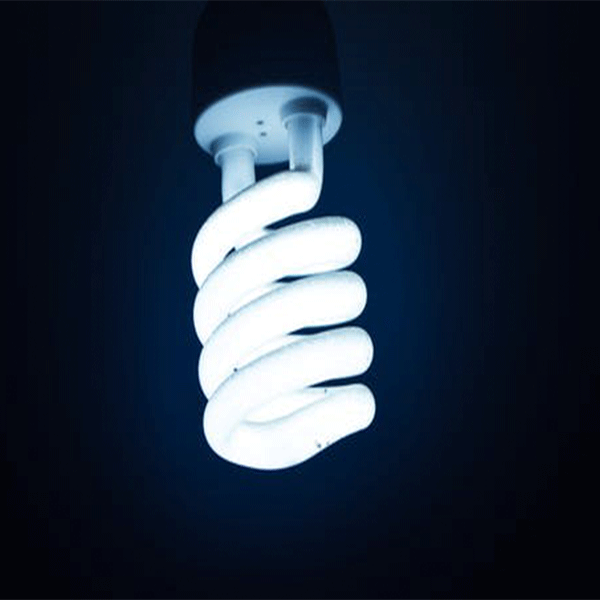
Because it is more convenient for the arrangement and design of various devices, it can better realize the effect of "seeing the light without seeing the light source" in the night scene lighting.
The full spectrum of LED light source color range is very suitable for the atmosphere of the shopping mall. The advantages of LED light source in local lighting, key lighting and regional lighting can create a high-quality light environment that other traditional lighting electric light sources cannot match, which is very suitable for commercial lighting network as well.
LED light source has small volume and solid-state lighting, which gives the lighting manufacturers unlimited space to play. It can produce all kinds of different styles of LED lighting professionally, and the full spectrum of arbitrary colors and dynamic and static lighting effects of LED make its decorative and manufacturing functions incisively and vividly displayed in such places.
Museums, art galleries and other places are special occasions with high requirements for lighting environment. The particularity of their display items requires that the lighting source does not contain ultraviolet rays and no thermal radiation. LED is a cold light source, the light does not contain ultraviolet rays, which can completely meet the special requirements of museums and art galleries for lighting.
With the increase of population and the change of life style, human beings are in the severe energy consumption and heavy environmental pressure. The global lighting power consumption accounts for more than 20% of the total power generation, so the action of energy conservation is urgent.


