

 |


TVC005
| Quantity: | |
|---|---|
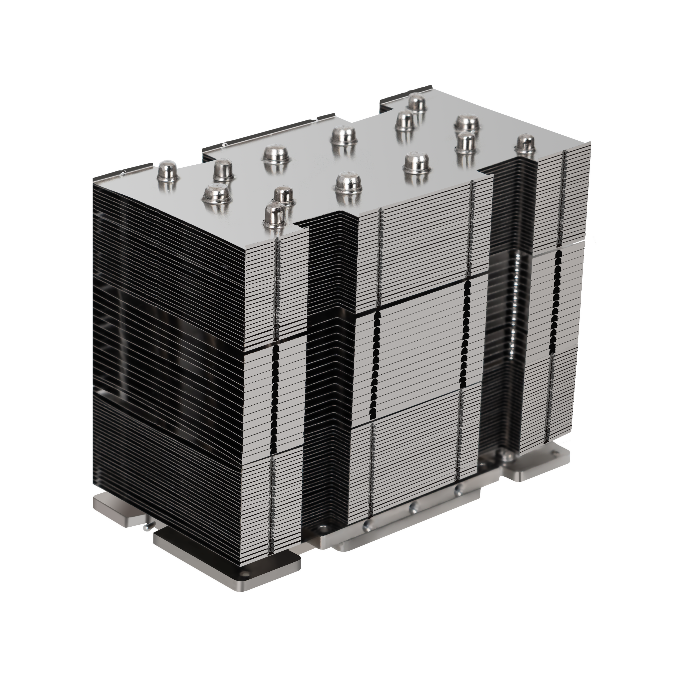
AI Training Servers: Large-scale training clusters equipped with multiple Nvidia H100 GPUs
High-Performance Computing Centers: GPU computing nodes for scientific computing, financial modeling, and other fields
Cloud Service AI Infrastructure: High-performance AI instance hardware for public cloud providers
Enterprise AI Platforms: Dedicated AI computing equipment deployed in private datacenters
Nvidia H100 GPUs generate over 700W of thermal power under full load, posing three core challenges to traditional cooling solutions due to their heat flux density and total thermal load:
Heat Density Limit Challenge: Extremely high heat flux density in GPU core areas, which traditional cooling solutions cannot effectively dissipate
Space vs. Noise Balance: Simultaneous requirement for cooling efficiency and noise control within standard server racks
Long-Term Operational Reliability: Datacenter 7×24 continuous operation demands exceptional durability from cooling solutions
Energy Efficiency Ratio Optimization Pressure: The cooling system's own power consumption directly impacts datacenter PUE metrics
Traditional heat pipe heatsinks experience local thermal saturation under high heat flux density
Standard fin arrays provide insufficient heat exchange efficiency under limited static pressure
Material and process limitations lead to performance degradation over long-term use
Inability to fully unlock the sustained high-performance operation potential of H100 GPUs
The revolutionary design of TVC005 lies in the system-level integration of three-dimensional vapor chamber technology and precision cold forging processes, achieving a fundamental breakthrough in cooling architecture:
Three-Dimensional Heat Spreading Capability: Achieves efficient heat conduction simultaneously in the X, Y, and Z dimensions, fundamentally solving GPU hotspot dissipation challenges
Sub-Millimeter Temperature Uniformity: Ensures temperature differential across the entire GPU package surface is less than 2°C, maximizing chip performance stability
Thickness-Direction Optimized Design: Optimizes internal capillary structure for the H100 chip package, enhancing vertical thermal conductivity
High-Density Fin Array: Cold forging achieves fin density exceeding 100 FPI (Fins Per Inch), maximizing heat exchange surface area
Enhanced Structural Strength: Monolithic forming process ensures heatsink structural integrity under vibration conditions
Interface Contact Optimization: Precision machining ensures microscopic conformity between heatsink base and GPU lid
Excellent Environmental Resistance: Nickel-plated surface effectively resists corrosive gases common in datacenters
Long-Term Thermal Interface Stability: Prevents increased interfacial thermal resistance due to oxidation, maintaining long-term cooling performance
Enhanced Assembly Compatibility: Improves compatibility with various thermal interface materials
Computational Fluid Dynamics (CFD) Simulation: Multiple rounds of CFD optimization based on actual server airflow paths
Precise Thermal Resistance Network Modeling: Custom thermal path design based on H100 GPU power distribution characteristics
Reliability Accelerated Validation: Rigorous testing including thermal cycling, vibration, and long-term aging tests
Maintains GPU Peak Boost Clocks: Stable, low-temperature environment ensures H100s sustain operation at maximum boost clocks
Increases AI Training Throughput: Reduces training interruptions from thermal throttling, improving overall computational efficiency
Extends Hardware Service Life: Reduces GPU junction temperature by 15-20°C, significantly extending chip lifecycle
Reduces Cooling System Energy Consumption: Efficient cooling reduces reliance on HVAC systems, lowering PUE by 0.05-0.08
Increases Rack Density: Supports higher-density GPU deployment with equivalent cooling capacity
Reduces Operational Complexity: Eliminates need for complex liquid cooling infrastructure, simplifying datacenter design
Accelerates Time-to-Market: Plug-and-play design reduces system integration validation cycles
Lowers Total Cost of Ownership (TCO): Excellent energy efficiency achieves positive ROI within a 3-year cycle
Technology Differentiation Advantage: Transforms advanced cooling technology into a core product competitive edge
Q:Do you have your own brand? A:Yes. Our brand name is GREATMINDS. |
Q:Are you a manufacture or trading company? A:We design and produce thermal products by ourselves. |
Q:Where is your plant? A:We have two plants. One is at Suzhou in eastern China, and the other is at Dongguan in southern China. |
Q:What thermal products do you supply? A:We have heatsink, fan, heapipe, vapor chamber, liquid cooling solution, and so on. |
Q:Which types of heatsinks do you supply? A:Our products cover many processes, extrusion, die casting, skived fin, zipper fin, soldering,friction stir welding, vaccum brazing, and so on. |
Q:What is the leadtime for prototype? A:It depends on different type of products. Usually it takes 2-3 weeks. |
Q:Do you have a NPI process in your company? A:Yes. Tooling samples and trial run will be strictly implemented before mass production. |
Q:What capabilities do you have in your plant? A:We have stamping, machining, and soldering production in house. |


