

 |


CP007
| Quantity: | |
|---|---|
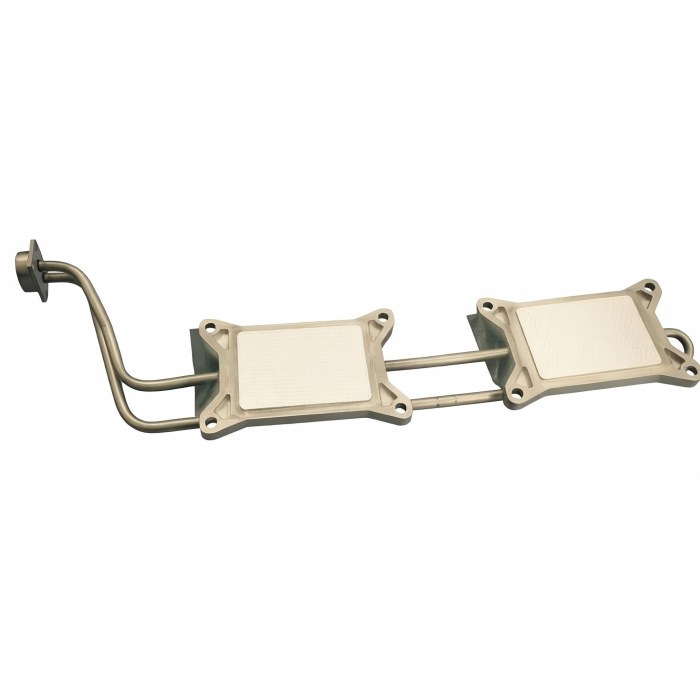
The CP007 is a precision aluminum brazing cold plate engineered for the most thermally demanding application in industrial photonics: high-power laser systems where multiple heat sources must be cooled simultaneously, independently, and to tightly controlled temperature targets.
At the core of CP007's design is a dual-cavity flow architecture: a single main inlet pipeline splits into two dedicatedcooling cavities — one per major heat source. This topology eliminates the thermal cross-talk that plagues single-channel cold plates, enabling each cavity to achieve synchronous yet independent precise temperature control regardless of the heat load differential between the two laser components being cooled.
Manufactured via aluminum brazing, CP007 offers the structural integrity and leak-proof reliability that industrial laser environments demand — with a chromate surface treatment providing corrosion resistance under the demanding conditions of laser system enclosures.
Dimensions are fully customized to your laser system's form factor and thermal envelope.
| Parameter | Details |
|---|---|
| Model | CP007 |
| Category | Cold Plate |
| Manufacturing Process | Aluminum Brazing |
| Dimensions | Fully Customized |
| Surface Treatment | Chromate |
| Application | Laser |
| Application Scenario | Heat dissipation for high-power industrial lasers |
| Core Innovation | Dual-cavity synchronous & independent precise temperature control |
High-power industrial laser systems typically house two dominant heat-generating components — such as a pump diode module and a gain medium, or two parallel laser heads — each with distinct thermal loads and temperature sensitivity profiles. A conventional single-channel cold plate routes coolant sequentially: the fluid heats as it absorbs energy from the first source, then arrives at the second source already pre-warmed — creating inherent temperature imbalance.
CP007 solves this with a manifold-split dual-cavity design. The main supply line divides at a precision-machined junction, delivering coolant at equal temperature and flow-split conditions to both cavities simultaneously. Each cavity operates as an independent thermal circuit, and both return to a common outlet — giving you:
Thermal synchrony: Both heat sources see identical coolant inlet temperature
Independent control: Flow rate, channel geometry, or external valve control can tune each cavity separately
Elimination of serial warm-up effect: No pre-heated coolant reaching the second component
In industrial laser environments, a single coolant leak can cause catastrophic optical damage — contaminating beam paths, corroding reflective optics, and destroying multi-thousand-dollar laser components in seconds. CP007 is manufactured by aluminum brazing, a process where filler metal is drawn by capillary action into all joint interfaces under controlled atmosphere furnace conditions, creating a continuous metallurgical bond across the entire cold plate assembly.
This means:
No mechanical joints or O-ring seals that fatigue, creep, or fail under thermal cycling
Leak-free performance across the full operating pressure and temperature range of industrial laser cooling loops
High internal pressure rating — brazed aluminum joints exceed the burst pressure of equivalent bolted cold plates
Uniform internal channel geometry — no distortion from assembly stresses
Unlike catalog cold plates designed around standard form factors, CP007 dimensions are fully specified to your laser system's mechanical envelope. Our engineering team works from your system drawings to define:
External footprint matched to your laser head or module mounting surface
Internal channel routing optimized for your specific heat source positions
Inlet/outlet port locations and thread specifications per your coolant loop design
Wall thickness calibrated to your operating pressure requirements
The result: a cold plate that installs as a precision component — not an adaptation.
Laser system enclosures present a corrosive microenvironment: residual flux from manufacturing, trace moisture, and aggressive cleaning agents used during optical alignment procedures all attack untreated aluminum surfaces. The chromate conversion coating on CP007 provides:
Uniform corrosion barrier across all external surfaces including coolant port threads
Electrical conductivity maintained — critical for grounding continuity in laser system chassis
Low contact resistance — compatible with EMI/RFI shielding requirements in laser power supply enclosures
Adhesion primer function — accepts paint, thermal interface materials, and adhesive mounting pads without surface pre-treatment
| Challenge | Standard Cold Plate Limitation | CP007 Solution |
|---|---|---|
| Two heat sources at different thermal loads | Serial flow pre-heats coolant before reaching second source — uncontrollable temperature differential | Manifold split delivers equal-temperature coolant to both cavities simultaneously |
| Independent temperature setpoints per heat source | Single-channel topology makes per-source temperature tuning impossible | Dual independent cavities allow per-channel flow modulation via external valves or differential channel sizing |
| Leak risk in laser optical path | Mechanical joint cold plates risk seal failure under thermal cycling — catastrophic if coolant reaches optics | Brazed aluminum construction eliminates all mechanical seals — continuous metallurgical bond throughout |
| System-specific mounting geometry | Standard catalog cold plates require mechanical adaptation — adds weight, thermal resistance, and assembly complexity | Fully custom footprint and port layout — no adaptation hardware needed |
| Corrosion from laser system environment | Bare aluminum attacks quickly under flux residue, moisture, and cleaning agents | Chromate conversion coating provides durable, conductive, paint-compatible corrosion barrier |
High-power fiber laser pump diode module cooling (kW-class systems)
Solid-state laser (Nd:YAG / Nd:YVO₄) gain crystal and diode array thermal management
CO₂ laser resonator electrode and excitation assembly cooling
Diode-pumped laser bar stack temperature stabilization
Laser welding / cutting head dual-module thermal regulation
Industrial laser chiller bypass — precision temperature trim for optical bench components
Laser marking system high-frequency duty-cycle heat removal
| Item | Specification |
|---|---|
| Flow topology | Main pipeline → dual-cavity manifold split |
| Temperature control mode | Synchronous + independent per cavity |
| Construction method | Controlled-atmosphere aluminum furnace brazing |
| Channel type | Custom-routed internal passages (straight, serpentine, or parallel array) |
| Surface treatment | Chromate conversion coating (MIL-DTL-5541 compatible) |
| Port options | G-thread, NPT, or custom flare/compression fittings |
| Pressure rating | Per design; brazed construction exceeds equivalent bolted configurations |
| Material | 3003 / 6061 aluminum alloy (per thermal and structural requirements) |
| Leak test standard | 100% helium leak test or hydraulic pressure test per customer specification |
Flow path architecture: dual-cavity manifold geometry, channel cross-section shape and dimensions
Heat source footprint matching: cavity zones positioned and sized per your laser component layout
Thermal performance targeting: channel density and flow rate specified to achieve your temperature uniformity requirement (e.g., ΔT ≤ 1°C across heat source footprint)
Mechanical interface: mounting hole pattern, surface flatness spec, external envelope constraints
Coolant compatibility: channel material selection and coating options for deionized water, glycol/water mix, or dielectric fluid loops
To initiate a design: provide your laser system layout drawing, heat source positions and dissipation values, coolant inlet temperature and flow rate parameters, and target outlet temperature or maximum component temperature — our team will return a preliminary design and thermal model within 5 business days.
Q: How does the dual-cavity design of CP007 achieve independent temperature control for two laser heat sources?A: The CP007 main inlet manifold splits coolant flow into two completely isolated internal cavities — one per heat source. Because each cavity receives coolant at the same inlet temperature simultaneously (not sequentially), there is no pre-heating effect between cavities. Per-cavity temperature can be further tuned by adjusting flow rate through external valves or by specifying different internal channel cross-sections per cavity during the design phase. This architecture is essential for laser systems where pump diode modules and gain media operate at different optimal temperatures — typically a 5–15°C differential that single-channel cold plates cannot resolve. |
Q: Why is aluminum brazing preferred over bolted or friction stir welded cold plates for laser applications?A: Laser systems cannot tolerate coolant leaks — even a micro-leak can contaminate beam paths, degrade reflective optics, and destroy multi-thousand-dollar optical components within seconds. Aluminum brazing creates a continuous metallurgical bond at every joint interface under controlled-atmosphere furnace conditions, eliminating all mechanical seals and O-rings that can fatigue, creep, or fail under thermal cycling. The result is a cold plate with inherently leak-free construction across its full pressure/temperature operating envelope, plus a burst pressure rating that exceeds equivalent bolted configurations by 30% or more. For industrial laser environments where uptime is measured in thousands of hours, brazed construction is the only sealing approach with proven long-term reliability. |
Q: What information is needed to begin a custom CP007 cold plate design, and what is the typical lead time?A: Our engineering team requires five key data points to initiate the design process:
With complete data, we return a preliminary design proposal including CFD thermal model results within 5 business days. |


