

 |


HP006
| Quantity: | |
|---|---|
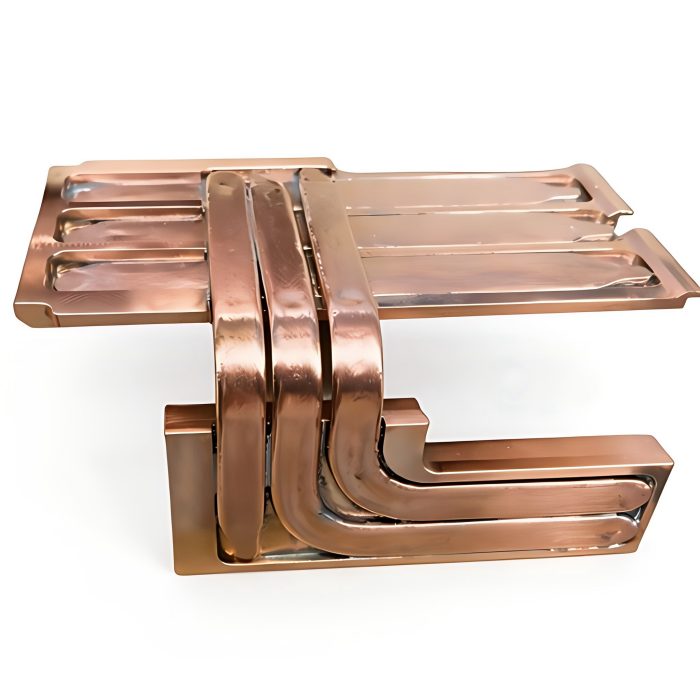
The HP006 Heat Pipe Heatsink is a precision-engineered copper thermal solution designed for the demanding requirements of CFP DCO (Coherent Digital Optical) optical modules and high-power optical transceivers deployed inside telecom and data-center optical communication chassis.
High-power coherent optical modules generate concentrated heat loads that conventional aluminum heatsinks struggle to distribute evenly. Unmanaged thermal gradients cause wavelength drift, elevated bit error rates (BER), and accelerated component aging — directly compromising link performance and network uptime.
HP006 solves this by integrating embedded heat pipes into a copper base plate, creating a two-phase heat-spreading platform that rapidly transfers heat from the module junction to the fin stack. Crucially, its symmetrical design spans two optical module positions, allowing a single HP006 unit to manage both modules simultaneously — delivering economies of scale that reduce per-module thermal management cost without any compromise in cooling performance.
| Parameter | Solid Aluminum Heatsink | HP006 (Copper + Heat Pipe) |
|---|---|---|
| Base thermal conductivity | ~150–200 W/m·K | Copper base: ~385 W/m·K |
| Effective spreading conductivity | ~150–200 W/m·K | 5,000–20,000 W/m·K (heat pipe) |
| Heat spreading mechanism | Conduction only | Two-phase evaporation + condensation |
| Hot-spot peak-to-average ΔT | High (localized) | Minimized (<5°C across module footprint) |
| Multi-module thermal coupling | Independent / no sharing | Symmetrical — matched ΔT across both modules |
| Weight penalty | Low | Moderate (copper density) |
Inside each embedded heat pipe, a small charge of working fluid undergoes a continuous two-phase cycle:
Evaporation at the hot end (module junction) — absorbs latent heat with negligible temperature rise
Vapor transport along the pipe axis — moves thermal energy at near-zero resistance
Condensation at the cool end (fin array) — releases heat to the airflow
Capillary return via sintered wick structure — wicks condensate back to the evaporator without pumps
This cycle delivers effective thermal conductivities 25–100× higher than solid copper, enabling HP006 to spread high, concentrated heat loads from the CFP DCO module footprint across the full fin array before convective cooling begins.
CFP DCO line cards typically carry modules in pairs. Conventional practice uses one heatsink per module — doubling component cost, assembly steps, and potential for thermal imbalance between adjacent ports.
HP006's single-body symmetrical architecture covers both module positions with one heatsink assembly:
Shared heat pipe network routes heat from both module contact pads into a common fin region
Mirror-image base geometry ensures equal thermal resistance from each module to the fin stack
Single-assembly mounting reduces line-card assembly time and eliminates per-module alignment variation
The result: both optical modules run at matched temperatures, ensuring symmetric optical power output, matched BER performance, and uniform aging — essential for coherent DWDM systems where optical asymmetry degrades system margin.
HP006's copper surfaces are finished with a chemical passivation treatment that:
Forms a thin, stable oxide barrier on the copper surface
Inhibits further oxidation and tarnishing in humid telecom environments
Maintains contact surface flatness and thermal interface quality over the product lifetime
Meets standard RoHS and telecom equipment cleanliness requirements
Unlike electroplated nickel, passivation preserves the natural high conductivity of the copper surface without adding significant thermal resistance at the module contact interface.
| Parameter | Value |
|---|---|
| Product Model | HP006 |
| Heatsink Type | Heat Pipe Heatsink |
| Base Material | Copper |
| Thermal Element | Embedded Heat Pipe(s) |
| Dimensions (L × W × H) | 76 × 31.5 × 50 mm |
| Surface Treatment | Passivation |
| Target Application | CFP DCO Optical Module, High-Power Optical Transceiver |
| Deployment Environment | Optical Communication Chassis (Telecom / Data Center) |
| Modules Covered | 2 (dual-module symmetrical design) |
| Airflow Requirement | Forced convection (chassis fan tray) |
| Custom Options | Fin pitch, heat pipe count/layout, mounting hole pattern, fin height |
CFP DCO coherent transceivers are among the most thermally demanding optical modules in deployment today. Operating at 100G–400G line rates, their DSP chipsets and modulator drivers generate heat fluxes of 10–25 W/cm² at the module lid — far above what passive conduction alone can reliably manage at the board density required by modern telecom chassis.
HP006 is designed for the slot-constrained, airflow-managed environment inside 1U/2U optical line cards:
Vertical fin orientation aligned with chassis airflow direction minimizes pressure drop across the heatsink
Compact 50 mm height fits within standard CFP DCO heatsink envelope without reworking the line-card PCB or chassis guide rails
Copper base contact surface achieves thermal interface material (TIM) coverage matching the full CFP DCO lid footprint
Dual-module span reduces the total number of thermal components per line card by 50%
Without adequate thermal management, CFP DCO modules in dense chassis experience a progressive failure chain:
Heat concentration at DSP/driver → junction temperature exceeds specification
Wavelength drift → coherent receiver detuning → SNR degradation
Elevated BER → increased FEC load → effective throughput reduction
Accelerated aging → MTBF reduction → unplanned field replacements
Port-to-port asymmetry (single-module heatsinks) → unbalanced optical power → system margin erosion
HP006's symmetrical, heat-pipe-enhanced thermal path interrupts this chain at the root — keeping both module junctions within specification under sustained full-load operation.
HP006 is available in standard configuration and as a fully customizable OEM platform. Our engineering team works directly with optical module, line-card, and chassis OEMs to adapt the design for specific requirements:
Modified base footprint to match non-standard CFP DCO or OSFP module lid geometry
Adjusted fin pitch and height for specific chassis airflow velocity and pressure-drop budgets
Custom heat pipe count, diameter, and routing to address asymmetric heat load distributions
Alternative surface treatments: electroless nickel plating, selective gold, or anodization for mixed-material assemblies
Prototype-to-production support: thermal simulation → prototype validation → mass production
Contact our thermal engineering team to receive a tailored thermal resistance estimate, 3D CAD file, and production lead-time quote for your application.
Why Choose HP006
| Requirement | HP006 Advantage |
|---|---|
| High heat flux from coherent DSP | Copper base + heat pipe two-phase spreading |
| Dual-module per slot | Single symmetrical assembly — 50% fewer heatsink parts |
| Thermal balance between ports | Mirror-geometry design — matched ΔT both modules |
| Corrosion resistance in telecom chassis | Passivation treatment — long-term surface stability |
| Chassis space constraint | 76 × 31.5 × 50 mm compact footprint |
| OEM volume procurement | Full custom design and tooling support |
HP006 is part of our Heat Pipe Heatsink product family. Explore related solutions: [TVC001 3D Vapor Chamber Heatsink for Coherent Optical Modules] · [VC002 Ultra-Thin Vapor Chamber Heatsink for QSFP-DD] · [Custom Heat Pipe Thermal Solutions]
Q:Do you have your own brand? A:Yes. Our brand name is GREATMINDS. |
Q:Are you a manufacture or trading company? A:We design and produce thermal products by ourselves. |
Q:Where is your plant? A:We have two plants. One is at Suzhou in eastern China, and the other is at Dongguan in southern China. |
Q:What thermal products do you supply? A:We have heatsink, fan, heapipe, vapor chamber, liquid cooling solution, and so on. |
Q:Which types of heatsinks do you supply? A:Our products cover many processes, extrusion, die casting, skived fin, zipper fin, soldering,friction stir welding, vaccum brazing, and so on. |
Q:What is the leadtime for prototype? A:It depends on different type of products. Usually it takes 2-3 weeks. |
Q:Do you have a NPI process in your company? A:Yes. Tooling samples and trial run will be strictly implemented before mass production. |
Q:What capabilities do you have in your plant? A:We have stamping, machining, and soldering production in house. |


